Minecraft Enchantments Guide 2026 - Best Enchantments for Every Item
Your diamond pickaxe is going to break. Mending fixes that permanently, and it's one of the best enchantments in the game that the enchanting table will never sell you. That gap between what the table offers and what you actually want is most of what enchanting is about, and the game explains almost none of it. None of the mechanics here have changed since 1.20, so use this on whatever version you play.
How Enchanting Works in Minecraft
There are two main ways to put enchantments on your gear:
- The enchanting table: Spend XP levels and lapis lazuli to apply a semi-random set of enchantments directly to an item. Most of your enchantments come from here.
- The anvil: Combine two items, or apply an enchanted book to an item, at the cost of XP. This is how you build "god gear" with the exact combination you want.
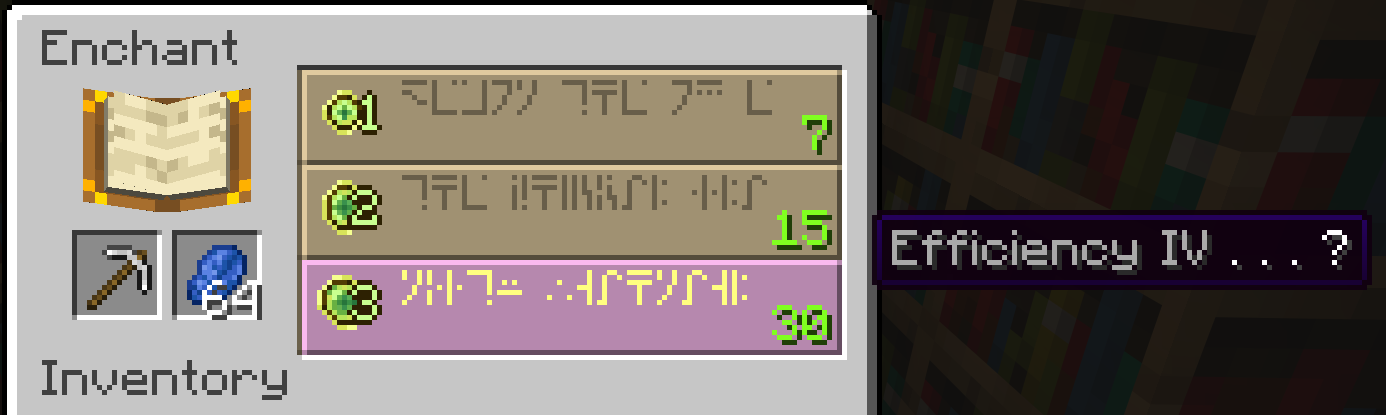
When you open an enchanting table, you'll see three offers on the right side. Each offer shows a level requirement (up to 30 with a full bookshelf setup) and one of the enchantments you'll receive. The offer may also include hidden bonus enchantments on top of the one shown. Every enchant costs both XP levels and 1-3 lapis lazuli, depending on which of the three slots you pick.
Two things about the table aren't obvious:
- The offers are seeded per-player. Closing and reopening the table, or walking to a different enchanting table, will not give you new offers. The three enchantments on display stay the same until you actually enchant something.
- To reroll the offers, enchant something cheap. Performing any enchantment rerolls all three slots. The classic trick: keep a stack of books next to your table, and when you don't like the offers, do a level-1 enchant on a book. It costs almost nothing and gives you three brand-new offers. Repeat until a level-30 slot shows the enchantment you're hunting for.
Building the Perfect Enchanting Table Setup
Before you can enchant anything, you need the table itself and enough bookshelves around it to unlock level-30 enchantments.
Step 1: Craft the Enchanting Table
The recipe is 4 obsidian + 2 diamonds + 1 book:
- Get 2 diamonds (if you're still short, our How to Find Diamonds guide covers the best Y levels and mining methods)
- Mine 4 obsidian with a diamond pickaxe (pour water over lava source blocks to make it)
- Craft 1 book from 3 paper (sugar cane) + 1 leather
- Combine everything in a crafting table: book on top, diamonds flanking obsidian in the middle row, obsidian across the bottom
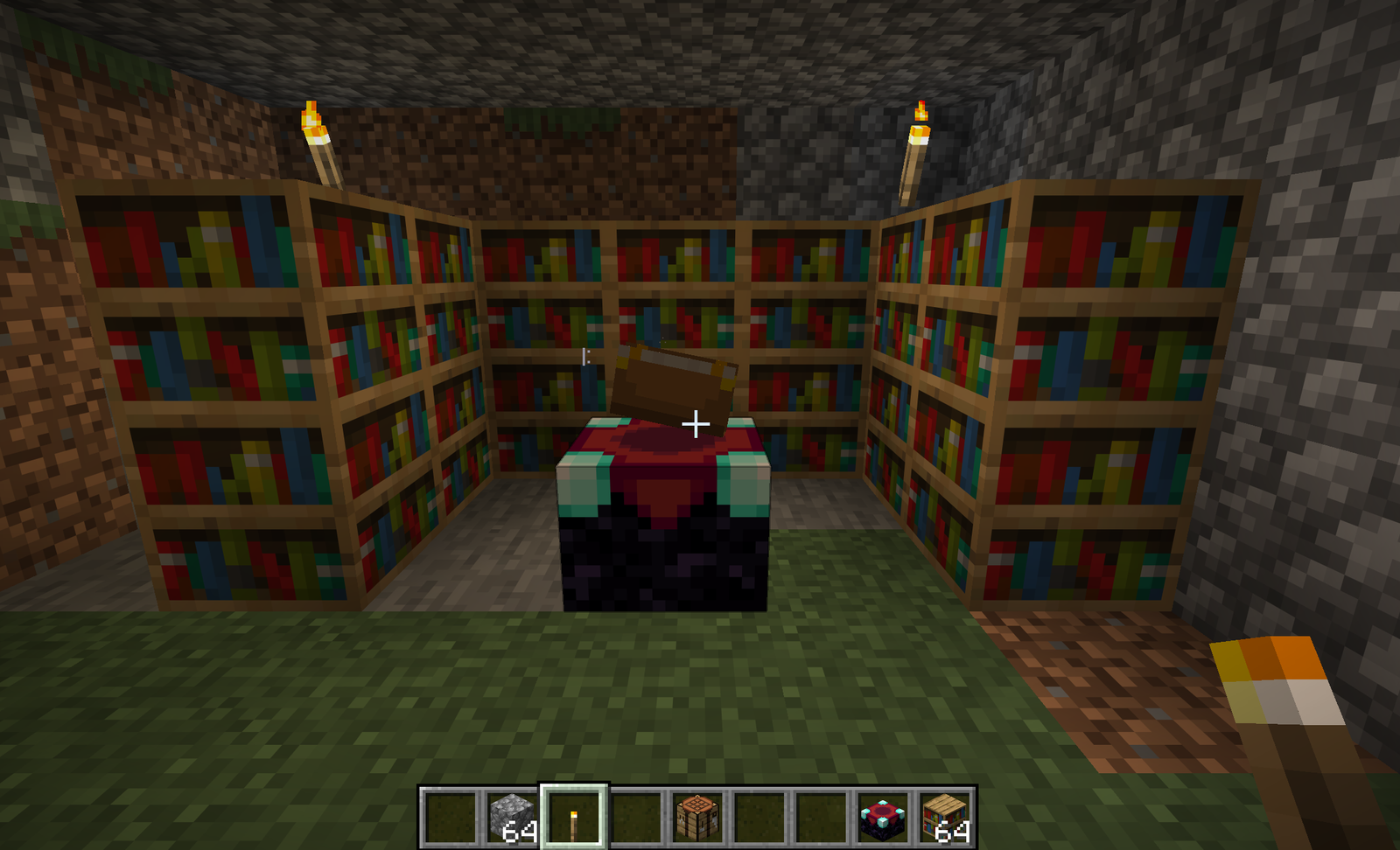
Step 2: Surround It with 15 Bookshelves
A bare enchanting table only offers weak enchantments. To unlock the maximum level-30 offers, you need 15 bookshelves placed around the table:
- Distance: Bookshelves must be exactly one block away from the table. The standard layout is a square ring around the table with a one-block gap
- Clear line of sight: The space between the table and the bookshelves must be air. Solid blocks (or even a torch or snow on that spot) will block a bookshelf from counting. Carpet and other very low blocks are fine, so you can carpet the gap for looks
- Bookshelf recipe: 6 planks + 3 books each. For all 15 shelves you'll need 90 planks and 45 books (45 leather + 135 paper), so set up a sugar cane farm and hunt some cows early
A common layout is a 5x5 square: table in the center, bookshelves around the outer edge (leaving a gap for a doorway), and the inner ring left open. Any arrangement works as long as 15 shelves are one block out with nothing solid in between.
Step 3: Stock Up on Lapis and XP
Every enchant consumes 1-3 lapis lazuli plus XP levels. A level-30 enchant requires you to be at least level 30 and costs 3 levels and 3 lapis (the level-1 reroll trick costs just 1 level and 1 lapis). Lapis is common while cave mining; keep a stack in the table's lapis slot so it's always ready.
Best Enchantments for Every Item
Here's the quick reference, followed by details and the reasoning for each item. "Must-have" is what every endgame version of the item should carry; "Nice-to-have" is situational or a matter of preference.
| Item | Must-have | Nice-to-have |
|---|---|---|
| Pickaxe | Efficiency V, Unbreaking III, Mending, Fortune III | Second pickaxe with Silk Touch |
| Sword | Sharpness V, Looting III, Unbreaking III, Mending | Sweeping Edge III (Java), Fire Aspect II, Knockback II |
| Axe | Efficiency V, Unbreaking III, Mending | Silk Touch or Fortune (situational) |
| Armor (all pieces) | Protection IV, Unbreaking III, Mending | Thorns III (chestplate) |
| Boots | Feather Falling IV, Depth Strider III | Soul Speed III (bastion loot only) |
| Helmet | Respiration III, Aqua Affinity | — |
| Bow | Power V, Unbreaking III | Flame, Punch II, Infinity or Mending (pick one) |
| Elytra | Unbreaking III, Mending | — |
Pickaxe
The perfect main pickaxe: Efficiency V, Unbreaking III, Mending, and Fortune III. Fortune III multiplies ore drops (more diamonds, more lapis, more coal from every vein), which makes it the most valuable mining enchantment in the game.
Silk Touch is mutually exclusive with Fortune, so you can't have both on one tool. Keep a second pickaxe with Silk Touch (plus Efficiency V, Unbreaking III, Mending) for grabbing whole blocks: glass, ice, glowstone, bookshelves, or ores you want to carry home and mine with Fortune later. Everyone ends up needing one.
Sword
The Java god sword: Sharpness V, Looting III, Unbreaking III, Mending, and Sweeping Edge III. Sharpness boosts every hit, Looting III multiplies mob drops (more ender pearls, gunpowder, and wither skeleton skulls), and Sweeping Edge turns your sweep attack into serious crowd control.
Optional extras:
- Fire Aspect II: Sets targets on fire — it even auto-cooks meat from animals you kill. The downside: burning endermen teleport away and it can complicate collecting creeper drops, so some players skip it
- Knockback II: Great for keeping mobs off ledges and away from you, but annoying when you're trying to chase a target down. Personal preference
Smite V and Bane of Arthropods V are mutually exclusive with Sharpness. Smite only affects undead mobs but hits them much harder than Sharpness, so it's the better pick for a dedicated wither-fighting sword or a zombie/skeleton farm sword. For a general-purpose sword, Sharpness wins because it works on everything.
Axe
Go with Efficiency V, Unbreaking III, and Mending. Silk Touch or Fortune are situational third picks depending on what you harvest. Worth remembering: in Java Edition, axes also deal very high damage per hit, so an enchanted axe doubles as a heavy-hitting backup weapon.
Armor (All Four Pieces)
Every piece should have Protection IV, Unbreaking III, and Mending. The four protection types (Protection, Fire Protection, Blast Protection, and Projectile Protection) are mutually exclusive on a single piece. The specialized types are stronger against their one damage source, but plain Protection IV is the best general pick because it reduces almost all damage types. Four pieces of Protection IV is the standard endgame loadout.
Boots
Boots carry the most extra enchantments of any armor piece:
- Feather Falling IV: Cuts fall damage hard. Once you have an elytra you'll be glad it's there
- Depth Strider III: Near-normal movement speed underwater. Frost Walker is mutually exclusive with Depth Strider; Frost Walker freezes water into walkable ice, a fun novelty, but Depth Strider is far more useful overall
- Soul Speed III: Lets you sprint across soul sand and soul soil. It only comes from bastion loot and piglin barters, never the enchanting table, and it slowly costs durability while active. Great for Nether highways
Helmet
On top of the standard armor trio, add Respiration III (much longer breath underwater) and Aqua Affinity (mine at normal speed while submerged). Together with Depth Strider boots, they make underwater ruins, monuments, and drowned farms comfortable.
Leggings
Leggings take the standard Protection IV / Unbreaking III / Mending set, plus one exclusive: Swift Sneak (levels I-III), which lets you walk at near-normal speed while sneaking. Swift Sneak only comes from Ancient City chests in the deep dark (it never appears on the enchanting table) and it only applies to leggings. It's the enchantment that makes sneaking past wardens practical.
Bow
Core setup: Power V, Unbreaking III, Flame, and optionally Punch II. The big decision is Infinity vs Mending, which are mutually exclusive:
- Infinity: One arrow lasts forever. Maximum convenience, but the bow will eventually break since you can't put Mending on it
- Mending: The bow repairs itself as you collect XP, lasting effectively forever, but you need a real arrow supply (a skeleton farm solves this)
Run Infinity early and switch to a Mending bow once durability starts to matter. Nothing stops you from keeping one of each.
Crossbow
Take Quick Charge III, Unbreaking III, Mending, and then choose between Multishot (fires three projectiles in a spread, great with fireworks) and Piercing (arrows pass through multiple mobs and can be picked back up). The two are mutually exclusive.
Trident
Tridents come in two builds because Riptide is mutually exclusive with both Loyalty and Channeling:
- Combat trident: Loyalty III (returns to you after throwing) + Channeling (summons lightning on hit during thunderstorms: charged creepers on demand) + Impaling V
- Travel trident: Riptide + Impaling V. Launches you through water and rain, and pairs well with an elytra
Elytra
Simple but critical: Unbreaking III + Mending. Elytra can't be crafted, so a Mending elytra that repairs itself from XP is effectively the difference between a renewable flight system and a consumable one.
How to Get Mending (and Other Treasure Enchantments)
Mending is the most important enchantment in the game, and you cannot get it from the enchanting table. It's a "treasure enchantment," the same category as Frost Walker, Soul Speed, Swift Sneak, and the curses: none of them ever show up in the table's offers. Mending repairs your gear using the XP orbs you collect. Orbs go toward fixing damaged Mending items you're holding or wearing before they feed your XP bar, so with Mending on everything, your gear simply never wears out.
Where Mending books come from:
- Librarian villager trading (best method): See the lectern trick below
- Fishing: Enchanted books are a treasure catch. Slow but passive, and a Luck of the Sea rod helps
- Chest loot: Dungeons, mineshafts, strongholds, and other generated structures can contain Mending books
- Raids: On Bedrock Edition, raid mobs can drop Mending books
The Librarian Lectern Trick
This is how you actually get Mending:
- Find or breed an unemployed villager (no job site, plain brown robes)
- Place a lectern next to them; they'll take the librarian profession and roll a random book trade
- Check their trades. If the enchanted book isn't Mending (or whatever you're hunting), break the lectern and place it again. The villager loses and re-takes the job with a freshly rolled trade
- Repeat until Mending appears, then trade with the villager once to lock in their profession permanently
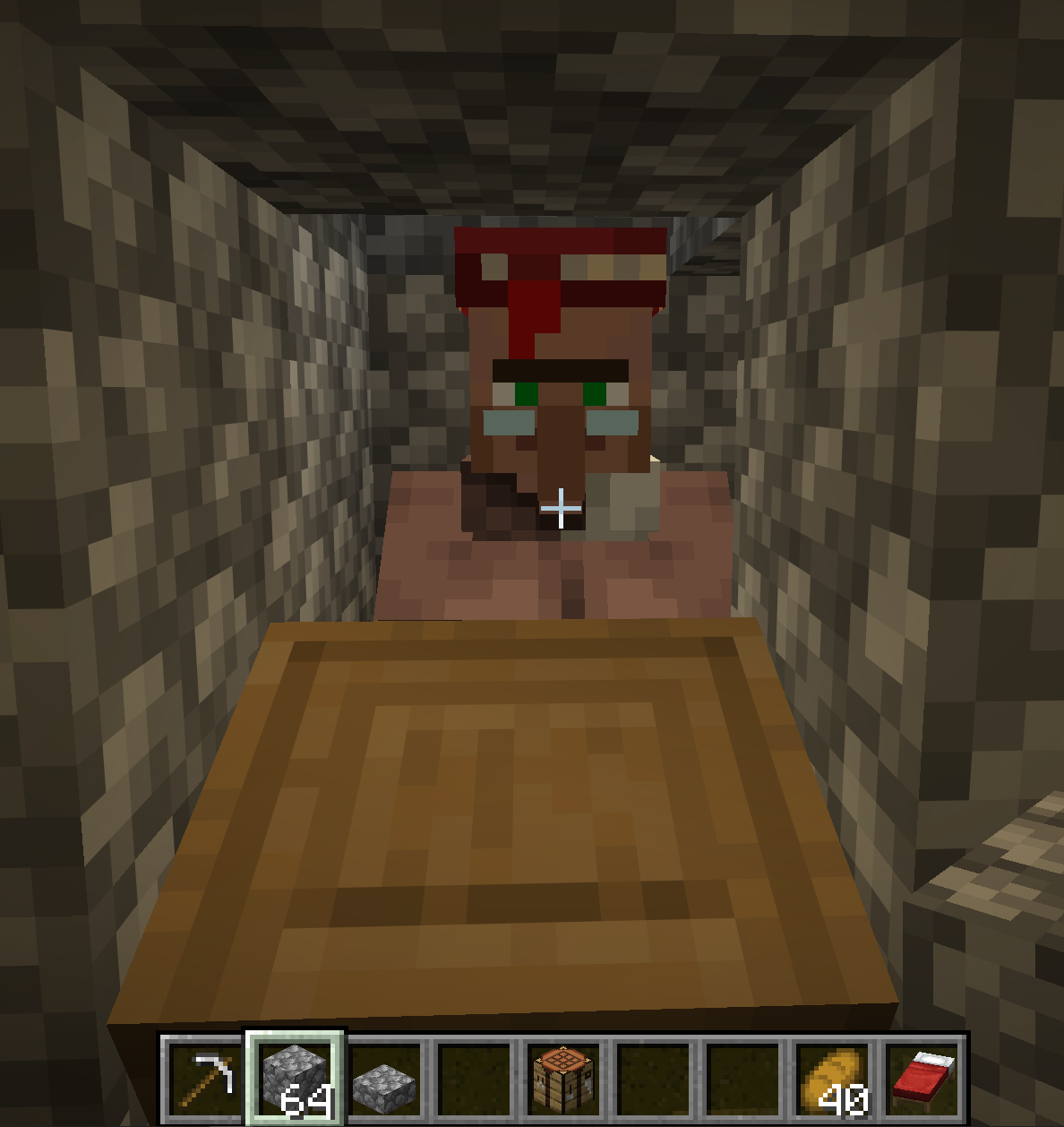
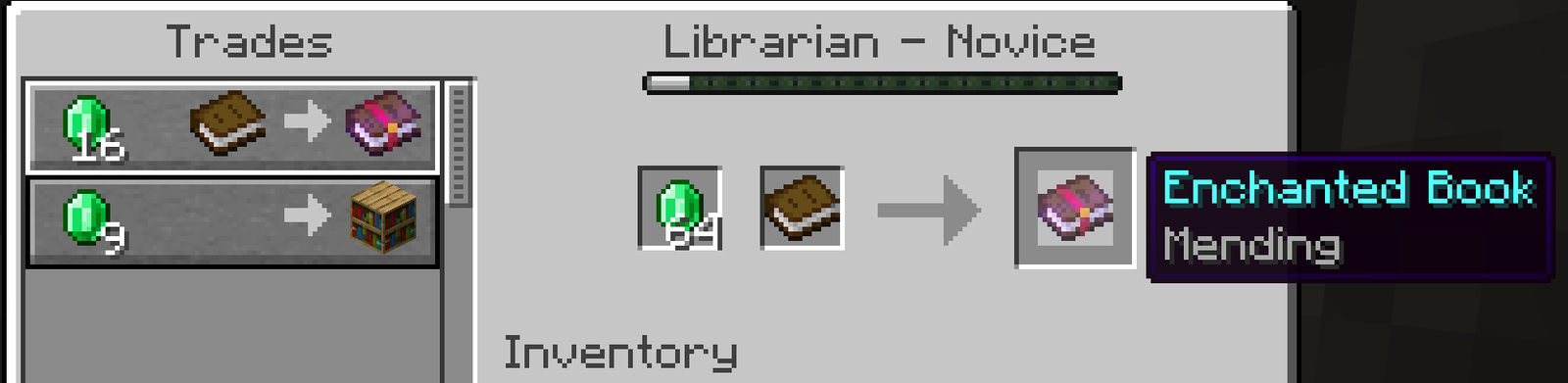
Once locked, that librarian sells you Mending books for emeralds forever. Set up a whole trading hall of locked librarians selling Mending, Efficiency V, Protection IV, and the other key books; at that point the enchanting table becomes almost optional.
Watch Out for Curses
Two treasure enchantments you don't want, found on loot and fishing gear:
- Curse of Vanishing: The item disappears completely when you die instead of dropping
- Curse of Binding: Once you put the armor piece on, you can't take it off until it breaks or you die
Check looted gear before wearing it, and note that a grindstone will not remove curses.
Anvil Combining: Building God Gear Without "Too Expensive!"
The enchanting table alone will rarely give you a perfect item. The endgame workflow is to collect enchantments on books and combine them onto your gear with an anvil, which takes two items (or an item plus a book) and merges their enchantments for an XP cost.
The catch is the prior work penalty: every time an item is worked on an anvil, its future anvil costs go up, and the penalty doubles with each operation. If a combination would cost more than 39 levels, the anvil refuses with "Too Expensive!", and the item can never be anvil-worked again in survival.
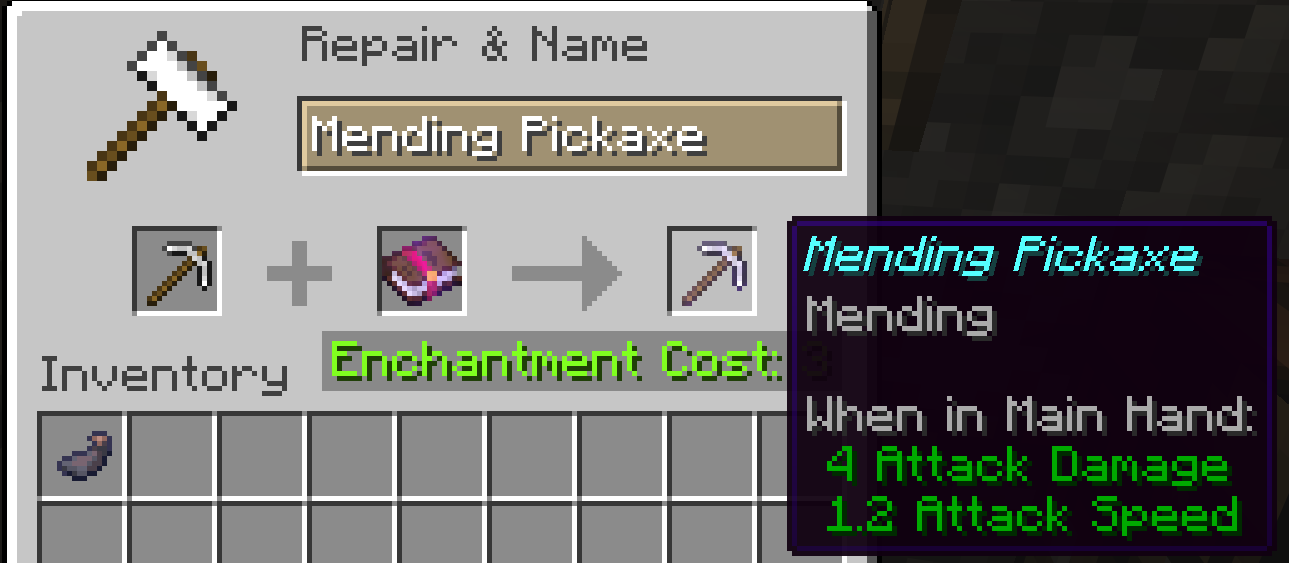
How to avoid it: combine cheap-to-cheap first.
- Merge your books together first. Combine single-enchant books into one multi-enchant book (for example: Protection IV + Unbreaking III on one book, Mending on another, then merge those two)
- Balance the tree. Combine pairs of books with similar work counts rather than repeatedly adding one book at a time to the same item — the doubling penalty punishes lopsided combining hard
- Apply the finished mega-book to the item in as few anvil operations as possible, ideally one
- Enchant the item on the table first if you can (table enchants add no work penalty), then book the rest on top
Two related tools worth knowing:
- Grindstone: Removes all enchantments from an item (except curses) and refunds some XP. Useful for stripping a badly-rolled item, resetting gear you looted, or farming XP from enchanted drops
- Smithing table: When you upgrade diamond gear to netherite, all enchantments carry over. Enchant your diamond gear fully, then upgrade. See our How to Find Netherite guide for the full upgrade process
Best XP Sources for Enchanting
Level-30 enchants and anvil work burn through XP fast, and Mending gear drinks XP orbs constantly. The best sources:
- Mob farms: A simple dark-room spawner farm works. An enderman farm in the End gets you to level 30 in a couple of minutes, with Looting-boosted drops on top. This is the classic endgame answer
- Sculk-block mining: Sculk blocks in the deep dark drop XP when mined. A Silk Touch-free sweep through a sculk patch is one of the fastest XP bursts in the game
- Villager trading: Every trade grants XP, so a trading hall pays you in emeralds, books, and levels at the same time
- Smelting: Bulk-smelting ores, stone, or kelp stores XP in the furnace that you collect on withdrawal (slow but completely AFK-friendly)
Remember how Mending interacts with XP: orbs repair damaged Mending gear you're holding or wearing before they feed your XP bar. To bank levels for anvil work, swap off your damaged gear first; to repair a specific item, hold it in your hand (or offhand) at the farm.
Common Enchanting Mistakes to Avoid
- Enchanting at low levels with no bookshelves: Weak enchants waste lapis and gear. Build the full 15-bookshelf setup before doing serious enchanting
- Blocking your bookshelves: A torch or block between the table and a shelf silently disables it. If you can't see level-30 offers, check the gap
- Enchanting stone or iron tools: Save your good rolls for diamond gear you'll later upgrade to netherite. Enchantments carry through the upgrade
- Combining expensive items repeatedly on the anvil: The doubling prior-work penalty will lock your item at "Too Expensive!". Merge books first, then apply once
- Putting Fortune and hoping for Silk Touch later: They're mutually exclusive. Plan for two pickaxes from the start
- Choosing Infinity and expecting to add Mending: Also mutually exclusive. Decide which bow you're building before you spend anvil levels on it
- Ignoring Mending: Without it, even netherite gear eventually breaks. Reroll a librarian early; it's worth the hour of setup
Frequently Asked Questions
How many bookshelves do I need for level 30 enchantments?
You need 15 bookshelves placed one block away from the enchanting table, with air (or low blocks like carpet) in the gap between them and the table. Each bookshelf costs 6 planks + 3 books, so the full setup takes 90 planks and 45 books. With 15 shelves in range, the third enchanting slot offers level-30 enchantments.
Why do I keep seeing the same enchantments at the table?
Enchantment offers are seeded per-player: closing the table, waiting, or using a different table won't change them. To reroll all three slots, perform any enchantment. The cheapest way is a level-1 enchant on a book, which costs 1 level and 1 lapis. Keep repeating until the level-30 slot shows the enchantment you want.
Can I get Mending from the enchanting table?
No. Mending is a treasure enchantment, so it will never show up in the table's offers no matter how many bookshelves you have. Your options are fishing, chest loot in generated structures, raid drops (Bedrock Edition), and librarian trading, which is the reliable one: a locked-in librarian sells Mending books for anywhere from 5 to 64 emeralds depending on the roll. Mending has no level II, so one book per item is all you'll ever need.
Is Sharpness or Smite better?
Sharpness V is better for a general-purpose sword because it boosts damage against every mob. Smite V deals more damage than Sharpness, but only against undead mobs (zombies, skeletons, the wither), which makes it the better pick for a dedicated wither-killing sword or an undead mob farm. The two are mutually exclusive, so the practical setup is a Sharpness sword as your main and a Smite sword as a specialist option.
Why does my anvil say "Too Expensive!"?
Every anvil operation adds a prior work penalty that doubles with each subsequent operation, and any combination costing more than 39 levels is refused in survival. Avoid it by combining cheap things first: merge your enchanted books together into one multi-enchant book, then apply that book to the item in a single anvil operation, rather than adding books to the item one at a time.
Should I pick Infinity or Mending on my bow?
They're mutually exclusive, so you must choose. Infinity means never crafting arrows again, but the bow will eventually break. Mending means the bow lasts forever as long as you collect XP, but you need an arrow supply (easy once you have a skeleton farm). Mending is the better long-term pick; Infinity wins on early convenience.
Do enchantments carry over when I upgrade diamond gear to netherite?
Yes. Upgrading at a smithing table preserves every enchantment on the diamond item, and it adds no anvil work penalty. That's why the standard order is: enchant your diamond gear fully first, then upgrade it to netherite. See our netherite guide for finding ancient debris and the smithing template.
Conclusion
Enchanting turns Minecraft's gear treadmill into a one-time project: build the table, hunt down Mending, combine your books smartly on the anvil, and you end up with self-repairing gear that lasts as long as you keep playing. The system looks random at first. It isn't. Between the book-reroll trick and the librarian lectern trick, every enchantment in this guide is fully within your control.
Quick Summary:
- Craft an enchanting table (4 obsidian + 2 diamonds + 1 book) and surround it with 15 bookshelves, one block away with clear gaps
- Stock lapis lazuli and reach level 30; reroll bad offers with cheap level-1 book enchants
- Enchant diamond gear with the must-haves: Efficiency V/Fortune III pickaxe, Sharpness V/Looting III sword, Protection IV armor, Feather Falling IV boots
- Get Mending books from a librarian using the lectern reroll trick, plus fishing and chest loot
- Combine enchanted books together first, then apply them to gear in one anvil operation to dodge the "Too Expensive!" cap
- Set up a steady XP source (mob farm, sculk mining, trading, or smelting) to power enchanting and keep Mending gear repaired
- Upgrade your finished diamond gear to netherite last; every enchantment carries over